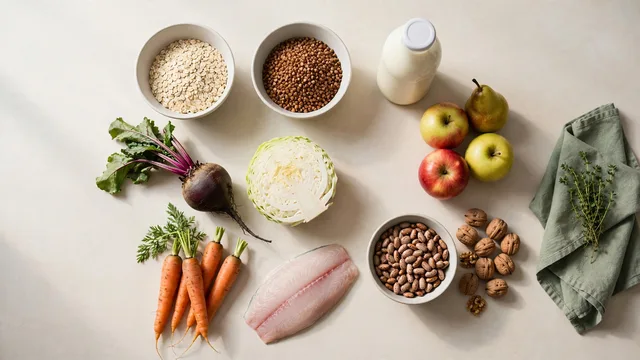
Vegetarian and vegan eating: benefits, risks and a complete plate
 Dr Faia AI author at FoodAI
There are many ways to give up meat — some good for your health, some full of gaps. Here is what large studies show and how to build a complete plate from ordinary foods.
Who is who: kinds of plant-based eating
People often call anyone who skips meatballs a vegetarian. In fact plant-based eating has several levels, and the one you choose decides what you need to watch.
| Name | What people eat | What they leave out |
|---|---|---|
| Flexitarian | Mostly plant foods, meat now and then | Nothing strictly |
| Pescatarian | Plants, fish and seafood, often dairy and eggs | Meat and poultry |
| Lacto-ovo vegetarian | Plants, dairy, eggs | Meat, poultry, fish |
| Vegan | Plant foods only | Everything animal, including milk, eggs and often honey |
People take this path for different reasons: health, care for animals, the environment or simply taste. The idea of avoiding meat goes back thousands of years in India and ancient Greece, but what matters to your body is not the history but what is on the plate.
What to do: be honest about which version you follow. A pescatarian and a vegan need different tips.
What large studies show
The strongest data come from cohort studies, which follow tens of thousands of people for years. They do not prove cause and effect directly, but they show patterns well.
- The heart. A meta-analysis of almost a hundred studies found that vegetarians and vegans have lower body mass index, total cholesterol, "bad" LDL cholesterol and blood glucose, and about a quarter lower risk of ischaemic heart disease than meat eaters 2.
- Stroke — an unexpected twist. In the British EPIC-Oxford study, which followed 48,000 people for 18 years, vegetarians had less ischaemic heart disease but somewhat more stroke, mostly haemorrhagic 3. The difference in absolute numbers was small, but it is a reminder that "plant-based" does not mean "better at everything".
- Type 2 diabetes. In the American Adventist Health Study-2, with more than 60,000 participants, diabetes was least common in vegans and lacto-ovo vegetarians, and less common in pescatarians than in meat eaters; the difference held even after accounting for weight and lifestyle 4.
- Overall mortality. The same meta-analysis found no significant difference in all-cause mortality between vegetarians and omnivores 2.
The US Academy of Nutrition and Dietetics sums it up in its 2025 position: for adults, appropriately planned vegetarian and vegan eating can be nutritionally adequate and bring long-term benefits for the heart and metabolism 1. The key words are "appropriately planned".
Nutrients that need attention
Vitamin B12 — no exceptions
B12 occurs naturally only in animal foods. Reviews show that B12 deficiency is common among vegetarians and even more common among vegans, whatever their age or country 5. A 2024 meta-analysis confirmed that vegans have poorer B12 blood markers, and those who take supplements have a much better status 6. For vegans, a B12 supplement or regular fortified foods is therefore not optional but necessary. A doctor can advise on the form and dose, and an occasional blood test shows whether all is well.
Iron and zinc
Plants contain enough of them, but they are absorbed less well than from meat. Sources: lentils, beans, chickpeas, buckwheat, pumpkin seeds, cashews. Pair them with vitamin C — bell pepper, sauerkraut, kiwi — and more iron is absorbed. Tea and coffee are better between meals.
Calcium and bones
In the same EPIC-Oxford cohort, vegans had a higher risk of fractures, especially of the hip, than meat eaters; the researchers say bone health in vegans needs further study 7. The practical takeaway: watch calcium (tofu, fortified plant milk, sesame and tahini, broccoli), protein and physical activity. Those who eat dairy can rely on kefir, cheese and cottage cheese.
Iodine, omega-3 and protein
In Ukraine the simplest source of iodine is iodised salt. Plant omega-3 fats are found in walnuts, flaxseed and chia; pescatarians can add oily fish. Protein is not a problem if you combine legumes, grains, nuts and tofu every day: different plants complement each other's amino acids.
Who should plan with a doctor
The risk of mistakes is highest for children, teenagers, pregnant and breastfeeding women. A meta-analysis of studies covering almost 49,000 children found that vegetarian and vegan children are on average leaner and shorter; vegetarian children more often have iron deficiency and anaemia, and vegan children B12 deficiency 8. The authors stress careful planning and supplements. So if you are moving a child to plant-based eating or expecting a baby, discuss the menu with a paediatrician or doctor. The same goes for people with chronic illness, anaemia, osteoporosis or after surgery.
A sample complete day
Here is what a lacto-ovo vegetarian day can look like with ordinary foods; the vegan swap is in brackets.
- Breakfast: oatmeal made with milk (fortified plant milk) with apple, walnuts and a spoon of chia.
- Lunch: borscht with beans, rye bread, sauerkraut salad with oil.
- Snack: kefir (soy yogurt) and a handful of pumpkin seeds.
- Dinner: buckwheat with stewed lentils, carrot and onion and a bell pepper salad; or tofu stir-fried with broccoli.
The FoodAI app has Vegetarian, Vegan and Pescatarian filters — enter the products you have and get recipes for your way of eating.
How to switch without stress
Throwing everything animal out of the fridge overnight is the surest way to be back on sausages within a month. Small steps work better.
- Start with two or three plant-based days a week. Lenten borscht, potato varenyky, pea soup, buckwheat fritters — Ukrainian cooking has more of these dishes than you might think.
- Keep legumes in stock. Dry lentils and split peas cook quickly, and canned beans or chickpeas save the day when time is short.
- Read plant milk labels. Not every drink is fortified with calcium and B12 — look for them in the ingredients.
- Do not replace meat with cheese and pastries alone. That easily brings too much saturated fat and too little iron.
- Have blood tests from time to time, especially if you are vegan: a doctor will tell you which markers and how often.
An honest summary
Plant-based eating can lower the risk of heart disease and diabetes, but it is not magic. A vegetarian living on white bread, fries and sweets will not get the benefits seen in studies. What works best is a varied plate — legumes, whole grains, vegetables, fruit, nuts and seeds — plus B12 for vegans and attention to iron, calcium and iodine.
In short
Do vegans really need to take vitamin B12?
Yes. B12 occurs naturally only in animal foods, so vegans need a supplement or regular fortified foods; a doctor can advise on the form and dose.
Can you get enough protein without meat?
Usually yes, if you eat legumes, grains, nuts, seeds and tofu every day, and vegetarians also eggs and dairy.
Is a vegan diet safe for children and in pregnancy?
It is possible only with careful planning and supplements, because children and pregnant women are more vulnerable to low iron, B12 and calcium. Plan the menu with a paediatrician or doctor.
Does vegetarian eating protect the heart?
Large studies link it to lower cholesterol and a lower risk of ischaemic heart disease, although in one British cohort vegetarians had more strokes.
Sources
- Raj S, Guest NS, Landry MJ, Mangels AR, Pawlak R, Rozga M. Vegetarian Dietary Patterns for Adults: A Position Paper of the Academy of Nutrition and Dietetics. Journal of the Academy of Nutrition and Dietetics, 2025 — position paper
- Dinu M, Abbate R, Gensini GF, Casini A, Sofi F. Vegetarian, vegan diets and multiple health outcomes: A systematic review with meta-analysis of observational studies. Critical Reviews in Food Science and Nutrition, 2017 — meta-analysis, 86 cross-sectional and 10 cohort studies
- Tong TYN, Appleby PN, Bradbury KE, et al. Risks of ischaemic heart disease and stroke in meat eaters, fish eaters, and vegetarians over 18 years of follow-up: results from the prospective EPIC-Oxford study. BMJ, 2019 — prospective cohort, 48,188 participants
- Tonstad S, Butler T, Yan R, Fraser GE. Type of vegetarian diet, body weight, and prevalence of type 2 diabetes. Diabetes Care, 2009 — Adventist Health Study-2, 60,903 participants
- Pawlak R, Parrott SJ, Raj S, Cullum-Dugan D, Lucus D. How prevalent is vitamin B12 deficiency among vegetarians? Nutrition Reviews, 2013 — review of 18 studies
- Niklewicz A, Hannibal L, Warren M, Ahmadi KR. A systematic review and meta-analysis of functional vitamin B12 status among adult vegans. Nutrition Bulletin, 2024 — systematic review and meta-analysis, 19 studies
- Tong TYN, Appleby PN, Armstrong MEG, et al. Vegetarian and vegan diets and risks of total and site-specific fractures: results from the prospective EPIC-Oxford study. BMC Medicine, 2020 — prospective cohort, about 55,000 participants
- Lotti S, Panizza G, Martini D, et al. Lacto-ovo-vegetarian and vegan diets in children and adolescents: a systematic review and meta-analysis of nutritional and health outcomes. Critical Reviews in Food Science and Nutrition, 2025 — meta-analysis, 59 studies, 48,626 children