What is a flexitarian diet, and is it safe? Less meat, done well
 Dr Faia AI author at FoodAI
Flexitarianism is not a ban but a change of proportions: most meals in the week are plant-based, meat comes now and then. Here is what research shows and how to rework a familiar Ukrainian menu without feeling deprived.
What “flexitarian” means
The word joins “flexible” and “vegetarian”. A flexitarian, or semi-vegetarian, diet is a mostly plant-based way of eating in which meat or fish appear only occasionally 3. There is no official standard: some people eat meat twice a week, others only at weekends or on holidays.
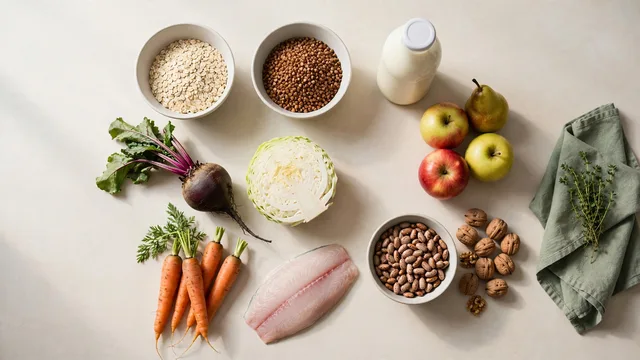
The main difference from vegetarianism is that nothing is forbidden. There is no list of “don’ts” and no need to ask in a café what the soup was cooked on. The aim is not to give meat up but to move it on the plate: from the daily lead role to a guest that turns up a few times a week. Most of the protein then comes from beans, lentils, peas, chickpeas, eggs, cottage cheese and cheese, nuts and seeds.
That flexibility has a flip side. Without clear rules, “less meat” can easily become “more white bread, varenyky with sour cream and biscuits”. Chips are plant-based too. The benefit comes not from the missing cutlet but from what takes its place.
What studies say about meat and legumes
In 2015 the International Agency for Research on Cancer (IARC), part of WHO, classified processed meat as Group 1, “carcinogenic to humans”, and red meat as Group 2A, “probably carcinogenic” 1. Processed meat means sausages, frankfurters, ham, bacon, smoked meats and canned meat. Red meat means beef, veal, pork and lamb. WHO explains that the strongest evidence concerns colorectal cancer and that the risk grows with the amount eaten 2.
An important caveat: the group shows how certain the evidence is that something can cause cancer, not how dangerous an ordinary portion is. A sausage is not “as harmful as tobacco”, even though both are in Group 1 2.
The picture for the heart and metabolism is similar. A meta-analysis of 20 studies linked every 50 g of processed meat a day with a 42% higher risk of coronary heart disease and a 19% higher risk of type 2 diabetes; for unprocessed red meat that analysis found no such link 4. Two large American studies that followed more than 120,000 people for decades found that replacing one daily serving of red meat with nuts, legumes, fish, poultry, low-fat dairy or whole grains was associated with a 7–19% lower risk of death 5.
A review of studies on flexitarian eating itself found signs of benefit for body weight, blood pressure, metabolic markers and type 2 diabetes risk, but described this evidence as still emerging 3.
To be fair, there is another side. These are mostly observational studies: they show a link but cannot prove that meat itself is the cause. In 2019 the NutriRECS group rated the evidence as low certainty and did not advise adults to cut down on meat 6. That recommendation sparked a heated debate among scientists. The safest conclusion today: cut down on sausages and smoked meats first, and replacing some red meat with legumes, fish or nuts is a sensible step with no known risks.
A plate for people and the planet
In 2019 the EAT–Lancet Commission proposed a “planetary health diet”: a reference diet built on vegetables, fruit, whole grains, legumes and nuts, with modest amounts of meat, especially red meat 8. Its authors argue that this is how people can be fed healthy food without exhausting land, water and climate — which is, in essence, a description of a flexitarian plate.
What to watch when meat becomes rare
A systematic review of 141 studies found that people on mostly plant-based diets (largely vegetarians and vegans) more often fall short on vitamin B12, vitamin D, iron, zinc, iodine and calcium, and get less of the omega-3 fats found in fish 7. A flexitarian who eats eggs, dairy and some meat and fish is at lower risk, but a few things are worth keeping in mind:
- Vitamin B12 is found only in animal foods: eggs, milk, cheese, fish, meat. If you now eat very little of them, ask your doctor about a blood test.
- Iron from beans, lentils and buckwheat is absorbed less well than from meat. Vitamin C on the same plate helps: sauerkraut, bell pepper, fresh herbs. Tea and coffee are better between meals.
- Zinc comes from legumes, pumpkin seeds, nuts, hard cheese and whole grains.
- Iodine comes from iodised salt instead of plain salt, and from sea fish.
- Omega-3 comes from oily fish (herring, mackerel) once a week and from walnuts.
Interestingly, the same review found gaps in meat-eaters too: they more often lack fibre, folate and magnesium 7. Nobody gets a perfect diet by default.
Talk to a doctor before changing your diet if you are pregnant or breastfeeding, are planning meals for children or teenagers, are older, or have anaemia, kidney disease or irritable bowel syndrome — legumes can cause a lot of bloating.
A realistic Ukrainian week
Dinner is the easiest place to start: it is the most home-cooked meal and depends least on the canteen at work. Here is what a first week might look like, with meat or fish kept at three dinners out of seven:
| Day | Dinner |
|---|---|
| Monday | Meatless borshch with beans and dried mushrooms |
| Tuesday | Buckwheat with mushrooms and onion, sauerkraut salad |
| Wednesday | Roast chicken with vegetables |
| Thursday | Lentil cutlets, beetroot and walnut salad |
| Friday | Mackerel or hake with potatoes and herbs |
| Saturday | Holubtsi (cabbage rolls) with rice and mushrooms |
| Sunday | Family dinner with meat, as usual |
Many Ukrainian dishes already have a meatless version — the twelve meatless dishes of Christmas Eve are proof of that. So there is nothing to invent:
- Borshch. Instead of meat stock, use a broth of dried mushrooms and add red beans for body and protein.
- Holubtsi. Fill them with rice or buckwheat, mushrooms, carrot and onion; cooked lentils work well too.
- Varenyky. Potato with fried onion and mushrooms, braised cabbage, cottage cheese — classics where nobody looks for meat.
- Cutlets. Lentils, beans or chickpeas with onion and buckwheat or oats. Cabbage and carrot cutlets are tasty but low in protein — serve them with a bean salad or an egg.
A halfway step for homes with committed meat-eaters: replace half the mince in cutlets or holubtsi with cooked lentils or finely chopped mushrooms. The taste barely changes, and there is half as much meat.
In short
Flexitarianism does not cure anything or work miracles, but it is easy to keep up for years because it forbids nothing. Start with two things: take sausages and frankfurters off the everyday menu, and make two or three dinners a week around legumes. The rest will follow.
In short
What is a flexitarian diet?
A mostly plant-based way of eating that does not forbid meat: most meals in the week are built on vegetables, legumes and grains, and meat or fish comes now and then.
Is a flexitarian diet safe?
For most adults, yes, as long as eggs, dairy, fish, legumes and nuts stay on the menu: they supply vitamin B12, iron, zinc, iodine and omega-3, which people on mostly plant-based diets more often fall short of. Pregnant or breastfeeding women, children, older people and anyone with anaemia or kidney disease should plan the change with a doctor.
How much meat does a flexitarian eat?
There is no single rule. Usually it means a few times a week instead of every day, with sausages and smoked meats cut down the most.
How is flexitarianism different from vegetarianism?
Vegetarians eat no meat at all; flexitarians just eat it less often. Nothing is forbidden, only the proportions change.
Will I get enough protein without meat every day?
A healthy adult usually will, if legumes, eggs, dairy, nuts or fish are on the menu every day. Children, pregnant women and older people should discuss their diet with a doctor.
Why is processed meat considered worse than fresh meat?
WHO classified sausages, ham and smoked meats as Group 1 carcinogens because of their link with bowel cancer, and eating them is also linked with heart disease and type 2 diabetes.
Sources
- Bouvard V, Loomis D, Guyton KZ, Grosse Y, et al. (IARC Monograph Working Group). Carcinogenicity of consumption of red and processed meat. The Lancet Oncology, 2015 — IARC Monographs summary
- World Health Organization. Carcinogenicity of red and processed meat (questions and answers) — WHO Q&A
- Derbyshire EJ. Flexitarian Diets and Health: A Review of the Evidence-Based Literature. Frontiers in Nutrition, 2017 — review of 25 studies
- Micha R, Wallace SK, Mozaffarian D. Red and processed meat consumption and risk of incident coronary heart disease, stroke, and diabetes mellitus: a systematic review and meta-analysis. Circulation, 2010 — meta-analysis of 20 studies, 1,218,380 people
- Pan A, Sun Q, Bernstein AM, Schulze MB, et al. Red meat consumption and mortality: results from 2 prospective cohort studies. Archives of Internal Medicine, 2012 — two cohorts, 121,342 people
- Johnston BC, Zeraatkar D, Han MA, Vernooij RWM, et al. Unprocessed Red Meat and Processed Meat Consumption: Dietary Guideline Recommendations From the NutriRECS Consortium. Annals of Internal Medicine, 2019 — guideline based on systematic reviews
- Neufingerl N, Eilander A. Nutrient Intake and Status in Adults Consuming Plant-Based Diets Compared to Meat-Eaters: A Systematic Review. Nutrients, 2021 — systematic review of 141 studies
- Willett W, Rockström J, Loken B, Springmann M, et al. Food in the Anthropocene: the EAT–Lancet Commission on healthy diets from sustainable food systems. The Lancet, 2019 — commission report