The paleo diet: what our ancestors ate and what is worth keeping
 Dr Faia AI author at FoodAI
The paleo diet promises a return to the “natural” eating of the Stone Age. Here is what archaeologists say about that age, what clinical trials say about the diet itself, and which part of it fits easily into an ordinary Ukrainian kitchen.
The idea: eat like hunter-gatherers
The paleo, or “ancestral”, diet rests on a simple thought. Farming and herding appeared about ten thousand years ago, which is a blink in evolutionary time. So, the argument goes, our bodies are still tuned to Palaeolithic food rather than to bread, sugar and sausage. Loren Cordain and colleagues set out this hypothesis in detail: in their view, newer foods changed the glycaemic load of the diet, the mix of fats, the amount of fibre, the sodium-to-potassium balance and the density of micronutrients, and this “mismatch” may lie behind many diseases of civilisation 1.
In practice, the popular paleo diet looks like this: meat, fish, eggs, vegetables, fruit, berries, nuts, seeds and mushrooms are in; grains, legumes, dairy, sugar and most industrially processed foods are out. Some versions also ban potatoes and salt.
Note that “diseases of civilisation caused by a mismatch” is a hypothesis, not a proven fact. So it is worth looking at what we actually know about how Stone Age people ate.
What Palaeolithic people really ate
The first thing anthropologists point out is that there was no single “paleo diet”. People lived in the tropics and near the ice sheets, and they ate whatever their surroundings offered. A review of studies of present-day hunter-gatherers (including the Hadza of Tanzania) and of archaeological finds shows that their diets tend to be less energy-dense and richer in fibre and micronutrients than modern ones, but they are by no means always low in carbohydrate 4. The popular plans with a very small share of carbohydrate are a modern invention, not a reconstruction of the past.
The second point: our ancestors ate plants, including the very ones the diet now forbids. Dental calculus of Neanderthals from caves in Iraq and Belgium held remains of grass seeds, legumes and dates, and some of the starch grains showed signs of cooking 2. Grinding stones about 30,000 years old from several European sites carried starch grains of wild plants, which suggests that people were making flour 3.
That leads to one more conclusion. Some fans of “ancestral eating” go further and say everything should be eaten raw, because fire is a mistake of civilisation. Archaeology says the opposite: people learned to cook a very long time ago, and cooking made food easier to digest 2.
What clinical trials show
The paleo diet has been tested in randomised trials, but there are few of them and they are small.
- In a Swedish trial, 29 people with ischaemic heart disease and impaired glucose metabolism ate either a paleo or a Mediterranean-style diet for 12 weeks. Glucose tolerance improved more in the paleo group, and their waists shrank more 5.
- In a two-year trial of 70 postmenopausal women with obesity, the paleo diet led to more fat loss in the first six months than the Nordic dietary recommendations. After two years the difference in fat mass was no longer statistically significant; the larger drop in triglycerides was what remained 6.
- A systematic review of four such trials (159 participants) found that, in the short term, the paleo diet improved some features of metabolic syndrome a little more than standard advice did: waist size, triglycerides, blood pressure. The authors rated the evidence as moderate and called for longer studies 7.
The honest summary: for a few months the paleo diet can help with weight loss and some blood tests. Whether that is thanks to “ancient genes” is unknown. The simplest explanation is that people stop eating sweets, pastries, sausages and snacks and eat more vegetables and fruit instead. There is no long-term data on heart disease, lifespan or fractures.
What you lose without grains, legumes and dairy
The weakest part of the paleo diet is its bans. A large analysis of 185 cohort studies and 58 clinical trials linked high intakes of dietary fibre and whole grains with a lower risk of cardiovascular disease, type 2 diabetes and colorectal cancer; the best results were seen at 25–29 g of fibre a day 8. Wholegrain bread, buckwheat, oats, beans and lentils are among the cheapest sources of that fibre. You can cross them out and still reach the target, but it is hard.
Legumes are also an inexpensive source of protein. Without them a diet leans more on meat, which makes it pricier. Dairy foods such as kefir, cottage cheese and yoghurt are the main source of calcium for many people; anyone who drops them has to look for calcium elsewhere on purpose, and a doctor or dietitian can help with that. Strict bans are also hard to keep for years: in the two-year trial, participants never reached the planned protein intake 6.
The useful part: paleo, Ukrainian style
You don’t need the whole rulebook to take the best of it. This is where the paleo diet genuinely agrees with current nutrition science:
| Principle | How to do it |
|---|---|
| Less industrially processed food | Roast chicken, eggs or stewed meat instead of sausages and frankfurters |
| Plenty of vegetables | Cabbage, beetroot, carrots, pumpkin, onions: seasonal and cheap |
| Fish instead of some meat | Mackerel, herring or hake once or twice a week |
| Nuts and seeds | A handful of walnuts, pumpkin or sunflower seeds |
| Berries and fruit for dessert | Apples, plums, frozen berries in winter |
| Little added sugar | Unsweetened tea, no sugary drinks or daily biscuits |
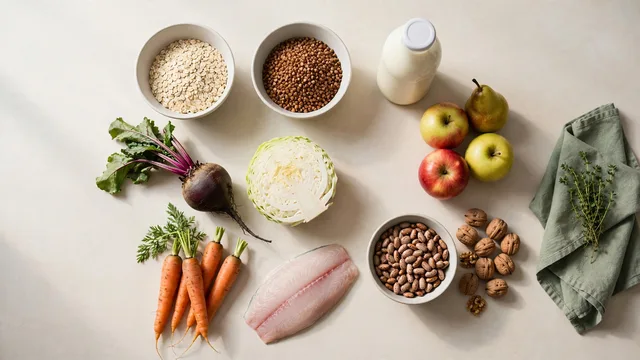
Buckwheat, oats, rye bread, beans, lentils and fermented dairy are better kept. The result is a diet that keeps the core of “paleo”, real and minimally processed food, and loses nothing.
There is no need to fear potatoes either: boiled in their skins or baked, they are filling and supply potassium; it is the deep fryer that does the harm. Nor does salt have to go completely. It is enough not to add salt at the table and to buy smoked meats, crisps and ready-made sauces, where most of it hides, less often.
A practical step for this week: swap one ready-made convenience food in your basket for fresh vegetables and fish, and cook a simple dinner from them, such as baked mackerel with beetroot and a cabbage salad.
Who should not follow the paleo diet
A strict version is not something to try on your own if you have kidney disease, are pregnant or breastfeeding, have an eating disorder, or take medicines for diabetes or blood pressure, since a sharp change in diet may mean the treatment needs adjusting; it is also not for children and teenagers. In all these cases talk to a doctor first. This article is general information and does not replace a consultation.
In short
Does the paleo diet help you lose weight?
In short trials, yes, mostly because sweets and processed food disappear from the menu. After two years its advantage in fat mass over ordinary healthy eating was no longer statistically significant.
Is it true that Palaeolithic people ate no grains or legumes?
No. Neanderthal teeth carried remains of grass seeds and legumes, some of them cooked, and tools about 30,000 years old show traces of grinding plants.
Can I take only the useful part of the paleo diet?
Yes: more vegetables, fish, nuts and berries, less sugar and sausage, while keeping buckwheat, oats, legumes and fermented dairy.
Who should avoid the paleo diet?
People with kidney disease, pregnant women, children, people with eating disorders and anyone treated for diabetes or blood pressure, unless a doctor agrees.
Sources
- Cordain L, Eaton SB, Sebastian A, et al. Origins and evolution of the Western diet: health implications for the 21st century. American Journal of Clinical Nutrition, 2005 — review, the hypothesis behind the paleo diet
- Henry AG, Brooks AS, Piperno DR. Microfossils in calculus demonstrate consumption of plants and cooked foods in Neanderthal diets (Shanidar III, Iraq; Spy I and II, Belgium). PNAS, 2011 — archaeological study of dental calculus
- Revedin A, Aranguren B, Becattini R, et al. Thirty thousand-year-old evidence of plant food processing. PNAS, 2010 — starch grains on grinding tools from three European sites
- Pontzer H, Wood BM, Raichlen DA. Hunter-gatherers as models in public health. Obesity Reviews, 2018 — review, including new data from the Hadza
- Lindeberg S, Jönsson T, Granfeldt Y, et al. A Palaeolithic diet improves glucose tolerance more than a Mediterranean-like diet in individuals with ischaemic heart disease. Diabetologia, 2007 — randomised trial, 29 participants, 12 weeks
- Mellberg C, Sandberg S, Ryberg M, et al. Long-term effects of a Palaeolithic-type diet in obese postmenopausal women: a 2-year randomized trial. European Journal of Clinical Nutrition, 2014 — randomised trial, 70 participants, 2 years
- Manheimer EW, van Zuuren EJ, Fedorowicz Z, Pijl H. Paleolithic nutrition for metabolic syndrome: systematic review and meta-analysis. American Journal of Clinical Nutrition, 2015 — systematic review, 4 randomised trials, 159 participants
- Reynolds A, Mann J, Cummings J, et al. Carbohydrate quality and human health: a series of systematic reviews and meta-analyses. The Lancet, 2019 — 185 prospective studies and 58 clinical trials