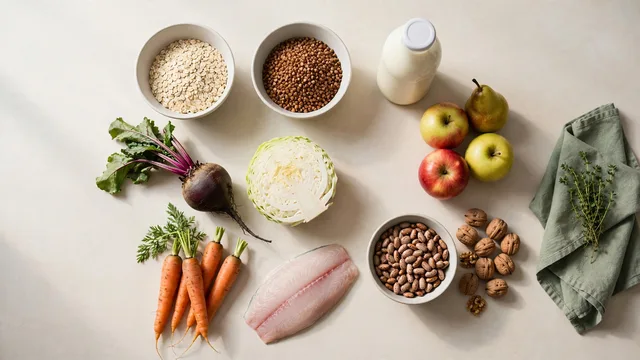
The MIND diet: food for the brain and what the research really says
 Dr Faia AI author at FoodAI
MIND is often called the “brain diet”. Here is where the name comes from, what scientists found, where the result turned out more modest than hoped, and how to eat this way with what is in an ordinary Ukrainian shop.
What MIND is
MIND stands for Mediterranean-DASH Intervention for Neurodegenerative Delay. Chicago researchers took the core of two well-studied patterns, the Mediterranean diet and DASH (an eating plan against high blood pressure), and reshaped it around foods earlier studies had linked with slower brain ageing 1.
MIND differs from its “parents” in a few details. It singles out green leafy vegetables and berries, but does not ask for lots of fruit in general, lots of dairy or potatoes, and it settles for one fish meal a week instead of fish almost every day 1.
The original MIND score has 15 food groups: 10 “brain-healthy” ones and 5 to limit 1. The rough targets look like this:
| More of | How often (guide) |
|---|---|
| Green leafy vegetables | 6 or more servings a week |
| Other vegetables | every day |
| Berries | 2 or more times a week |
| Nuts | 5 or more times a week |
| Beans, lentils, chickpeas | more than 3 times a week |
| Whole grains | 3 or more servings a day |
| Fish | at least once a week |
| Poultry | 2 or more times a week |
| Olive oil | the main oil at home |
The score asks you to limit red meat (fewer than 4 times a week), butter and margarine (less than a tablespoon a day), cheese (less than once a week), pastries and sweets (fewer than 5 times a week) and fried food and fast food (less than once a week) 1. Wine is also in the score, but that is no reason to start drinking: WHO advises cutting down hazardous drinking precisely for the sake of the brain 6.
What to do: use the table as a checklist, not an exam. What do you already eat, and what is missing?
What the first studies found
The first results came from the Memory and Aging Project in Chicago: people aged roughly 58 to 98 who reported their diet and took memory tests for years.
- Among 960 participants, those whose eating matched MIND most closely lost cognitive ability more slowly. The gap between the top and bottom thirds of scores was like being 7.5 years younger 1.
- Among 923 participants followed for 4.5 years on average, higher MIND scores went with a lower rate of Alzheimer’s disease, even with moderate adherence 2.
- A separate analysis of the same group found that about one serving of green leafy vegetables a day was linked with slower cognitive decline 3.
Observational studies show a link, not a cause. People who eat spinach and nuts often move more, have more education and look after their health in other ways, and no adjustment captures everything. The authors of the first paper themselves wrote that the findings needed testing in an intervention trial 1.
What the 2023 randomised trial showed
That test was done. In a randomised trial, 604 older adults without memory problems, but with a family history of dementia, excess weight and a less than ideal diet, were split at random into two groups. One followed MIND for three years, the other a standard control diet. Both groups cut calories slightly and received counselling and support 4.
The result: over three years, cognitive scores improved in both groups, and there was no statistically significant difference between MIND and the control diet. Brain changes on MRI were also similar in both groups 4.
That does not mean MIND “does not work” or does harm. The control group also changed its eating and lost weight, three years may be too short, and the participants were fairly healthy. But the honest conclusion is this: it has not yet been shown that the MIND set of foods protects the brain better than simply healthier eating with weight loss.
A related result came from the Spanish PREDIMED trial: older people at high cardiovascular risk who were given a Mediterranean diet with extra virgin olive oil or nuts scored better on memory and thinking than a control group advised to eat less fat. But the group was small and several tests showed no difference 5.
What else matters for the brain, according to WHO
In 2019 WHO issued guidelines on reducing the risk of cognitive decline and dementia 6. Food is only one item among many:
- Physical activity. For adults with normal cognition this is a strong recommendation.
- Stopping smoking and cutting down hazardous or harmful drinking.
- Diet. A Mediterranean-like diet may be recommended (a conditional recommendation), and a healthy, balanced diet in line with WHO advice should be recommended to all adults.
- No “brain” supplements. WHO does not recommend vitamins B and E, polyunsaturated fatty acid supplements or multi-nutrient pills to reduce the risk of dementia.
- Looking after health: treating high blood pressure and diabetes, high cholesterol in mid-life, excess weight, depression, and checking hearing.
The combined approach was tested in the Finnish FINGER trial: a two-year programme of diet, exercise, memory training and monitoring of blood pressure and blood sugar gave a small but significant advantage in cognitive tests compared with general health advice 7.
What to do: find your weakest point. A daily walk or a blood pressure check may do more than a new diet.
A MIND-style week with Ukrainian food
Most MIND foods are cheap. Frozen berries (blueberries, currants, sour cherries) are available all year. Spinach, sorrel, dill, parsley and lettuce can be joined by cabbage, although in the MIND score it counts among “other vegetables”. Beans, buckwheat, oats, herring and mackerel are in any supermarket.
About oil: the MIND and PREDIMED studies looked at olive oil 15, and there are no comparable brain studies of sunflower oil. At the same time, WHO lists sunflower oil, like olive oil, as a source of unsaturated fats, which are better than butter or lard 8. So if olive oil is too expensive, using sunflower oil instead of butter for stewing or salads is a sensible step too.
| Day | Ideas for the day |
|---|---|
| Monday | Oats with frozen blueberries; borscht with beans; buckwheat with braised cabbage |
| Tuesday | Wholegrain bread with hummus; spinach salad with walnuts; chicken with vegetables |
| Wednesday | Millet porridge with frozen cherries; lentil soup; baked mackerel with potatoes and dill |
| Thursday | Buckwheat porridge with nuts; green sorrel borscht; vinegret beetroot salad with beans |
| Friday | Spinach and blackcurrant smoothie; herring with onion and wholegrain bread; vegetable stew |
| Saturday | Omelette with herbs; pearl barley with mushrooms; chicken meatballs with salad |
| Sunday | Oat pancakes with berries; cabbage rolls with buckwheat; bean spread with vegetables |
This is an example, not a diet plan: fish twice a week, pulses almost daily, greens and berries regularly, fried food and pastries rarely.
Who should be careful
MIND is simply balanced eating and generally safe for healthy adults. But if you have kidney disease, gout, digestive trouble with beans, a nut allergy, or take medicines regularly, talk the changes through with your doctor. If you notice memory problems in yourself or someone close, that is a reason to see a doctor, not to change the menu on your own.
The main point: no diet guarantees protection against dementia. But a plate with greens, berries, pulses, fish and whole grains is good for the heart and blood vessels, and together with exercise and blood pressure control it gives the brain better conditions.
In short
Has the MIND diet been proven to prevent dementia?
No. Observational studies linked it with slower brain ageing, but a 2023 randomised trial found no significant difference compared with a control diet.
How is MIND different from the Mediterranean diet?
It puts special weight on green leafy vegetables and berries, and is less demanding about fruit in general, dairy, potatoes and fish.
Can I use sunflower oil instead of olive oil?
The MIND studies looked at olive oil, so there is no direct evidence for sunflower oil. WHO counts both as sources of unsaturated fat, better than butter.
Should I take supplements for memory?
WHO does not recommend vitamins B and E, polyunsaturated fatty acid capsules or multivitamins to reduce the risk of dementia.
Sources
- Morris MC, Tangney CC, Wang Y, et al. MIND diet slows cognitive decline with aging. Alzheimer's & Dementia, 2015 — prospective cohort, 960 older adults
- Morris MC, Tangney CC, Wang Y, et al. MIND diet associated with reduced incidence of Alzheimer's disease. Alzheimer's & Dementia, 2015 — prospective cohort, 923 participants
- Morris MC, Wang Y, Barnes LL, et al. Nutrients and bioactives in green leafy vegetables and cognitive decline: prospective study. Neurology, 2018 — prospective cohort, 960 participants
- Barnes LL, Dhana K, Liu X, et al. Trial of the MIND diet for prevention of cognitive decline in older persons. New England Journal of Medicine, 2023 — randomised trial, 604 participants, 3 years
- Valls-Pedret C, Sala-Vila A, Serra-Mir M, et al. Mediterranean diet and age-related cognitive decline: a randomized clinical trial. JAMA Internal Medicine, 2015 — randomised trial, 447 participants
- World Health Organization. Risk reduction of cognitive decline and dementia: WHO guidelines, 2019
- Ngandu T, Lehtisalo J, Solomon A, et al. A 2 year multidomain intervention of diet, exercise, cognitive training, and vascular risk monitoring versus control to prevent cognitive decline in at-risk elderly people (FINGER). The Lancet, 2015 — randomised trial, 1,260 participants
- World Health Organization. Healthy diet (fact sheet)