Intermittent fasting: 16:8, 5:2 and what the research shows
 Dr Faia AI author at FoodAI
Eating only eight hours a day, or barely eating twice a week, is a popular idea with a big reputation. Here is what stands behind it, how it differs from simply eating less, and how to avoid doing yourself harm.

What intermittent fasting is
Intermittent fasting is not a list of forbidden foods but a timetable. Periods of eating alternate with periods of no food at all, or very little 2. During the “empty” hours people usually drink water, or tea and coffee without sugar.
Researchers most often study three schemes 2:
| Scheme | What it looks like |
|---|---|
| 16:8 (time-restricted eating) | All meals fit into eight hours, for example 10:00 to 18:00. The other 16 hours are food-free. A gentler version is 14:10. |
| 5:2 | Five days a week you eat as usual; on two days you eat very little, a few hundred kilocalories. |
| Alternate-day fasting | A normal eating day alternates with a “fast day” of 0 to about 500 kcal. |
There are harsher versions too — a day or a day and a half without food. They carry the most risk, so they are not something to try on your own.
Autophagy and the Nobel Prize: what was actually discovered
Intermittent fasting is often sold with the word “autophagy”. From Greek it means “self-eating”: a cell wraps its own worn-out parts in a membrane sac and sends them to the lysosome — a kind of recycling plant where they are broken down into building material that can be reused 1.
In 2016 the Japanese biologist Yoshinori Ohsumi received the Nobel Prize in Physiology or Medicine “for his discoveries of mechanisms for autophagy”. In the early 1990s he used baker’s yeast to find the genes this process cannot work without, and then showed that similar machinery operates in human cells 1. Autophagy matters for adapting to a lack of food and for fighting infection, and faults in it are linked to cancer and neurological disease 1.
It is worth being clear about what the prize was not for. It was basic research into the cell’s inner workings, not a study of fasting in people. It does not prove that skipping breakfast rejuvenates or “cleanses” the body. Whether fasting lengthens human life remains a hypothesis that long-term studies have not tested.
What trials in people show
The key question is simple: is intermittent fasting better than just eating a little less every day? Here is what comparative randomised trials — where participants were assigned to a scheme by chance — found.
- Two “light” days a week. 107 women with excess weight spent six months either cutting calories sharply on two days a week or trimming their food a little every day. Weight fell by the same amount and most blood markers changed alike; insulin resistance dropped slightly more in the “light days” group 3.
- Alternate-day fasting. In a one-year trial of 100 adults with obesity, this scheme produced the same weight loss as daily calorie restriction. But more people dropped out of it, and on fast days they ate more than planned 4.
- 16:8 with no other changes. 116 adults ate only between 12:00 and 20:00 for 12 weeks. Their weight did not differ from a group that simply ate three meals a day. Among participants whose body composition was measured, the eating-window group lost more lean (muscle) mass 5.
- A window plus calorie counting. 139 people with obesity followed the same calorie target for a year, but half also ate only between 8:00 and 16:00. The differences in weight, body fat and metabolic markers were not significant 6.
A review of 11 meta-analyses covering 130 trials found benefits of intermittent fasting for weight, blood pressure, cholesterol and blood sugar. But most of this evidence is of low or very low quality, the studies mostly lasted only a few months, and fasting was also linked to a loss of lean body mass 7.
So intermittent fasting is one way of eating less, not a magic mechanism. It suits people who find it easier to skip a meal than to shrink their portions. If the window turns into overeating in the evening, it will do no good. An honest test is this: could you live on this timetable for months without breaking down or feeling drained? If not, a moderate cut in portions will get you the same result.
Risks and who should not fast
For a healthy adult, an overnight break of 12–14 hours is usually harmless. But in some situations experimenting without a doctor is dangerous.
- Diabetes and glucose-lowering medicines. In a trial of people with type 2 diabetes, fast days raised the rate of hypoglycaemia — a dangerous drop in blood sugar — even though medicine doses were reduced 8. Here only a doctor should set the regimen and the treatment.
- Muscle loss. It showed up in the studies 5 7 and is especially unwelcome in older people.
- Groups the schemes have hardly been tested in: pregnant and breastfeeding women, children and teenagers, people with a current or past eating disorder, people who are underweight or live with a chronic illness. They should not fast without talking to a doctor.
Fasting for a day or longer, let alone “dry” fasting without water, is not for do-it-yourself experiments. If you feel dizzy, weak or notice your heart racing while fasting, eat something and see a doctor.
How to build meals inside the window
When you eat less often, every plate counts for more. A few rules help you keep your muscles and avoid getting ravenous:
- Protein at every meal: eggs, cottage cheese, chicken, fish, lentils or beans.
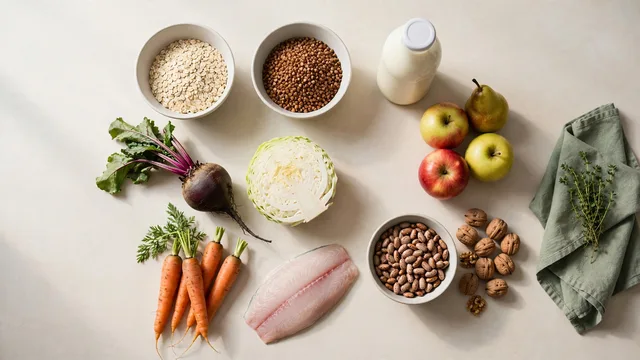
- Half the plate vegetables: cabbage, carrots, beetroot, cucumbers, tomatoes. They give volume and fibre for few calories.
- Whole grains instead of white bread and sweets: buckwheat, oats, brown rice.
- Do not “open the window” with a bun and coffee — after a break, sugar wears off fast and hunger comes back.
A sample day with a 10:00–18:00 window:
- 10:00 — a two-egg omelette with tomatoes and a slice of rye bread, or oats soaked in kefir with grated apple and a few walnuts.
- 14:00 — buckwheat with braised chicken and a cabbage and carrot salad, or a meatless borscht with beans.
- 17:30 — stewed lentils with vegetables, or baked cottage cheese pancakes (syrnyky) with a glass of kefir.
For the light days of 5:2, a vegetable soup, a boiled egg, low-fat cottage cheese and a salad work well: lots of volume, few calories. Start gently — just stop eating late at night so the overnight break lasts 12 hours — and see how you feel.
In short
Can I drink coffee while fasting?
Water, tea and black coffee without sugar are usually fine in the empty hours. Milk, cream and sugar already count as food.
Does 16:8 work faster than an ordinary diet?
In comparative trials with the same calorie intake, the difference in weight was not significant. The scheme helps people who find it an easier way to eat less.
Does fasting switch on autophagy and rejuvenation?
The 2016 Nobel Prize was for the mechanism of autophagy discovered in yeast, not for research on fasting in people. There is no evidence that any fasting scheme rejuvenates humans.
Who should not fast without a doctor?
Pregnant and breastfeeding women, children and teenagers, people with eating disorders, people who are underweight, and anyone with diabetes or another chronic illness.
Where should a beginner start?
With an overnight break of 12–14 hours: have dinner earlier and skip late snacks. Eat full meals with protein and vegetables inside the window.
Sources
- The Nobel Assembly at Karolinska Institutet. Press release: The Nobel Prize in Physiology or Medicine 2016 (Yoshinori Ohsumi, for his discoveries of mechanisms for autophagy), 2016 — official press release
- Varady KA, Cienfuegos S, Ezpeleta M et al. Clinical application of intermittent fasting for weight loss: progress and future directions. Nature Reviews Endocrinology, 2022 — review
- Harvie MN, Pegington M, Mattson MP et al. The effects of intermittent or continuous energy restriction on weight loss and metabolic disease risk markers: a randomized trial in young overweight women. International Journal of Obesity, 2011 — randomised trial, 107 women, 6 months
- Trepanowski JF, Kroeger CM, Barnosky A et al. Effect of alternate-day fasting on weight loss, weight maintenance, and cardioprotection among metabolically healthy obese adults: a randomized clinical trial. JAMA Internal Medicine, 2017 — randomised trial, 100 adults, 1 year
- Lowe DA, Wu N, Rohdin-Bibby L et al. Effects of time-restricted eating on weight loss and other metabolic parameters in women and men with overweight and obesity: the TREAT randomized clinical trial. JAMA Internal Medicine, 2020 — randomised trial, 116 adults, 12 weeks
- Liu D, Huang Y, Huang C et al. Calorie restriction with or without time-restricted eating in weight loss. New England Journal of Medicine, 2022 — randomised trial, 139 adults, 12 months
- Patikorn C, Roubal K, Veettil SK et al. Intermittent fasting and obesity-related health outcomes: an umbrella review of meta-analyses of randomized clinical trials. JAMA Network Open, 2021 — umbrella review, 11 meta-analyses, 130 trials
- Corley BT, Carroll RW, Hall RM et al. Intermittent fasting in Type 2 diabetes mellitus and the risk of hypoglycaemia: a randomized controlled trial. Diabetic Medicine, 2018 — randomised trial, people with type 2 diabetes