Wheat bread by DSTU 7517:2024: moisture, acidity, shelf life
 Dr Faia AI author at FoodAI
We buy bread every day and rarely think that it has a standard with numbers in it. Since May 2025 wheat bread in Ukraine has been described by the new DSTU 7517:2024. Here is what it says, what it leaves out, and what is worth knowing at the shop.
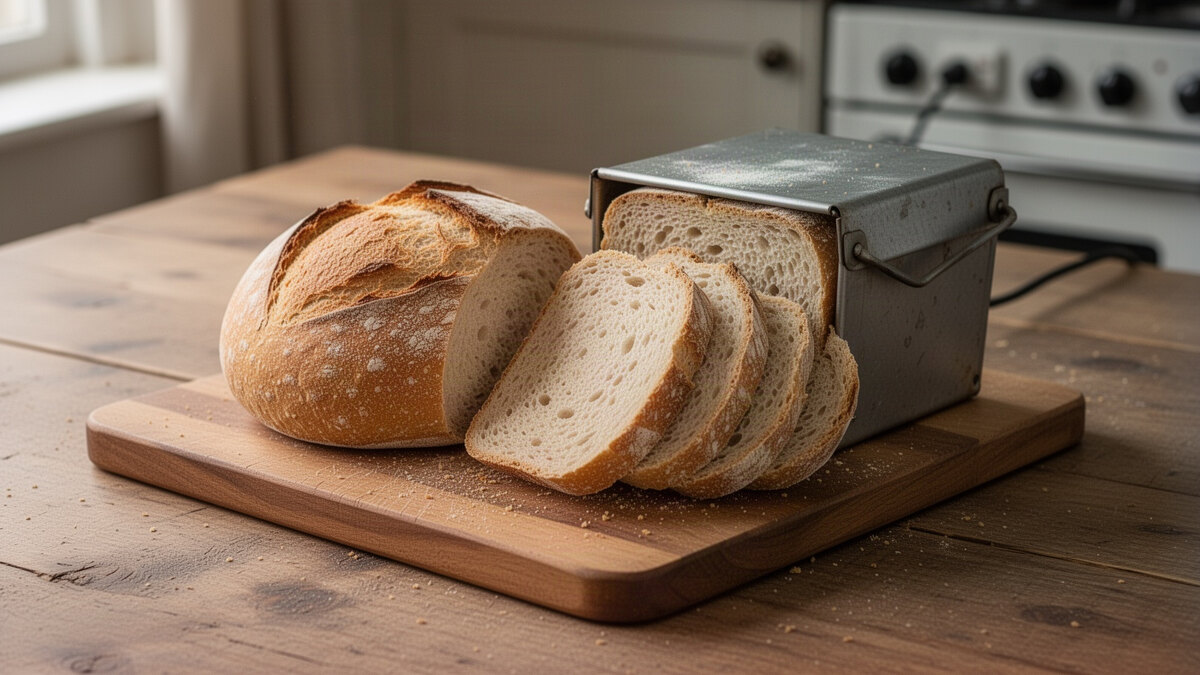
A new standard for everyday bread
DSTU 7517:2024 “Bread from wheat flour. General technical conditions” was adopted by order No. 281 of the state enterprise UkrNDNC of 15 November 2024, has been in force since 1 May 2025, and replaced DSTU 7517:2014 1. It covers bread from wheat flour of various grades or their mixture — finished, finished frozen, and frozen semi-products (section 1) 1. Bread may be hearth bread (baked on the oven floor without a tin) or tin bread (cl. 4.3) 1.
The exact formulation, and with it the precise limits for each named bread, the standard leaves to the approved formulation and the technological instruction (cl. 5.1, 5.1.6) 1. It prints no fermentation regimes and no acidity for dough or sponge. What it does set is a general ceiling and floor that no bread may cross.
The three key numbers: moisture, acidity, porosity
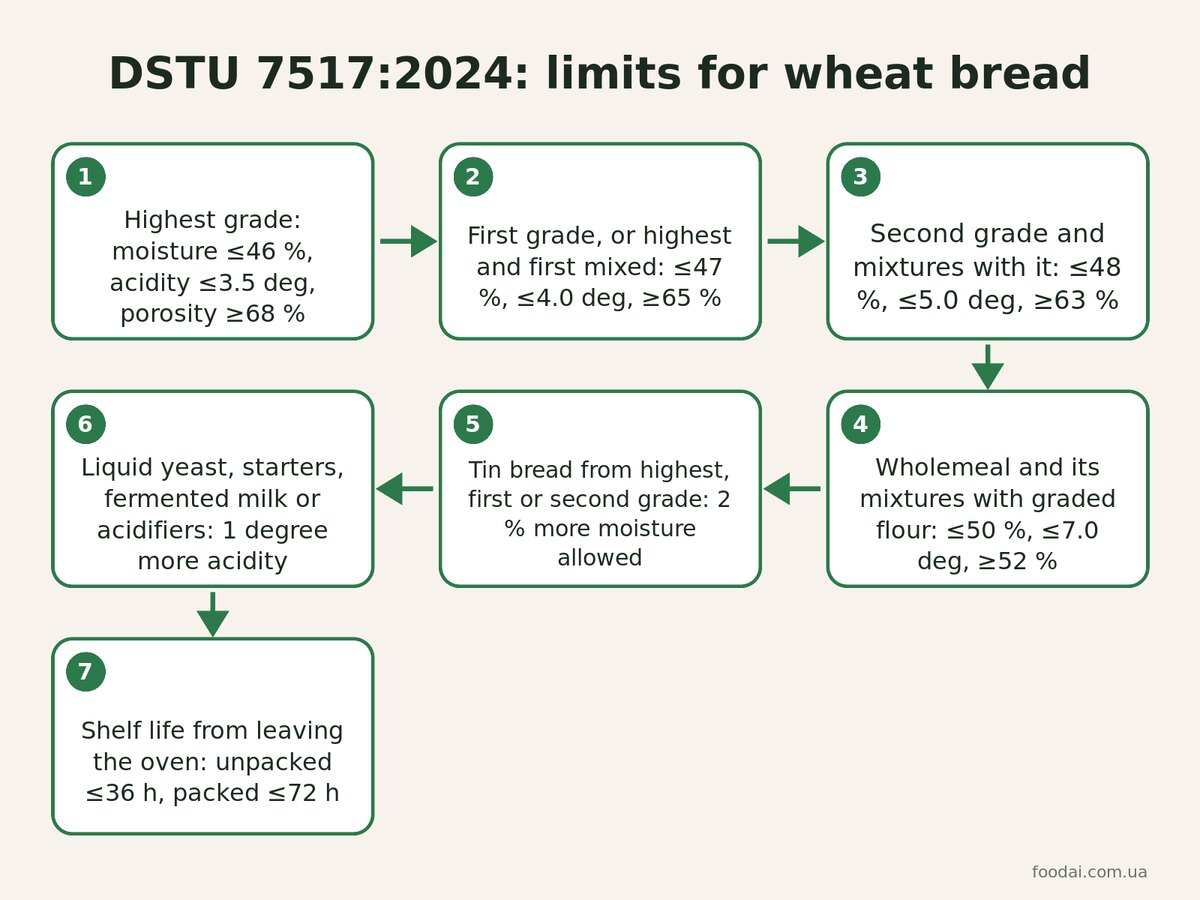
Table 3 of the standard sets these limits by flour grade (test methods under DSTU 7045) 1:
| Flour | Crumb moisture, % max | Acidity, degrees max | Porosity, % min |
|---|---|---|---|
| Highest grade | 46.0 | 3.5 | 68.0 |
| First grade; highest and first mixed | 47.0 | 4.0 | 65.0 |
| Second grade and mixtures with it | 48.0 | 5.0 | 63.0 |
| Wholemeal and their mixtures with graded flour | 50.0 | 7.0 | 52.0 |
Crumb moisture is the share of water in the soft part of the loaf. The higher it is, the more water and the less dry matter in the same weight of bread. For tin bread from highest, first, second grade flour and their mixtures the standard allows 2 % more (note 1 to Table 3) 1.
Acidity is the titratable acidity of the crumb, which for bread is expressed in degrees. It shows how much acid built up during fermentation. If liquid yeast, lactic starters, fermented milk products or other acidifiers were used, 1 degree more is allowed (note 3) 1. Bread from wholemeal flour has the highest limit, 7.0 degrees.
Porosity is the share of crumb volume taken up by pores. It is normed only for items over 0.2 kg and not for bread with dried fruit, nuts, seeds or grain additions (cl. 5.1.6) 1.
Sugar and fat on a dry-matter basis are checked only when the formulation has more than 2 kg of sugar and more than 2 kg of fat per 100 kg of flour; the tolerance is ±1.0 % for sugar and ±0.5 % for fat, and an excess is not a reason for rejection (Table 3, note 5) 1.
What bread should look like
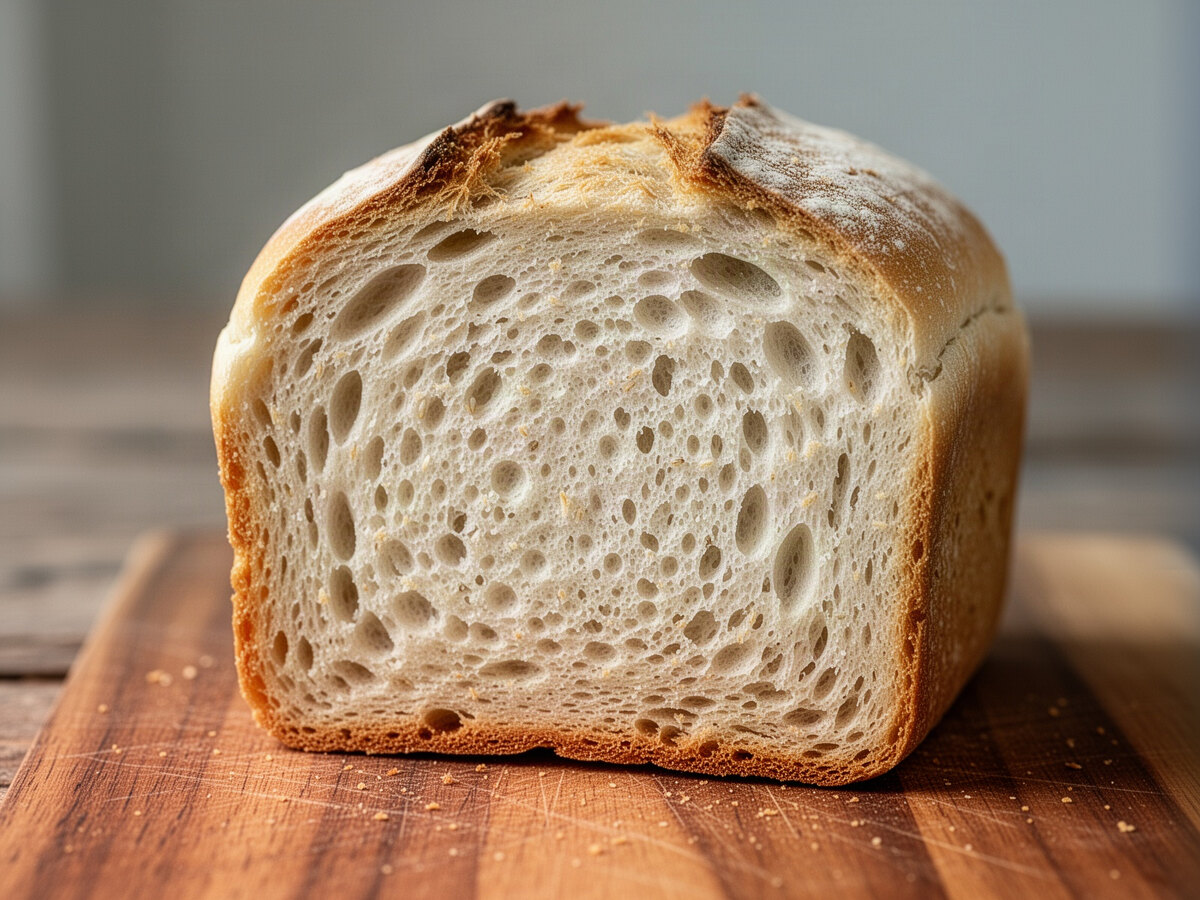
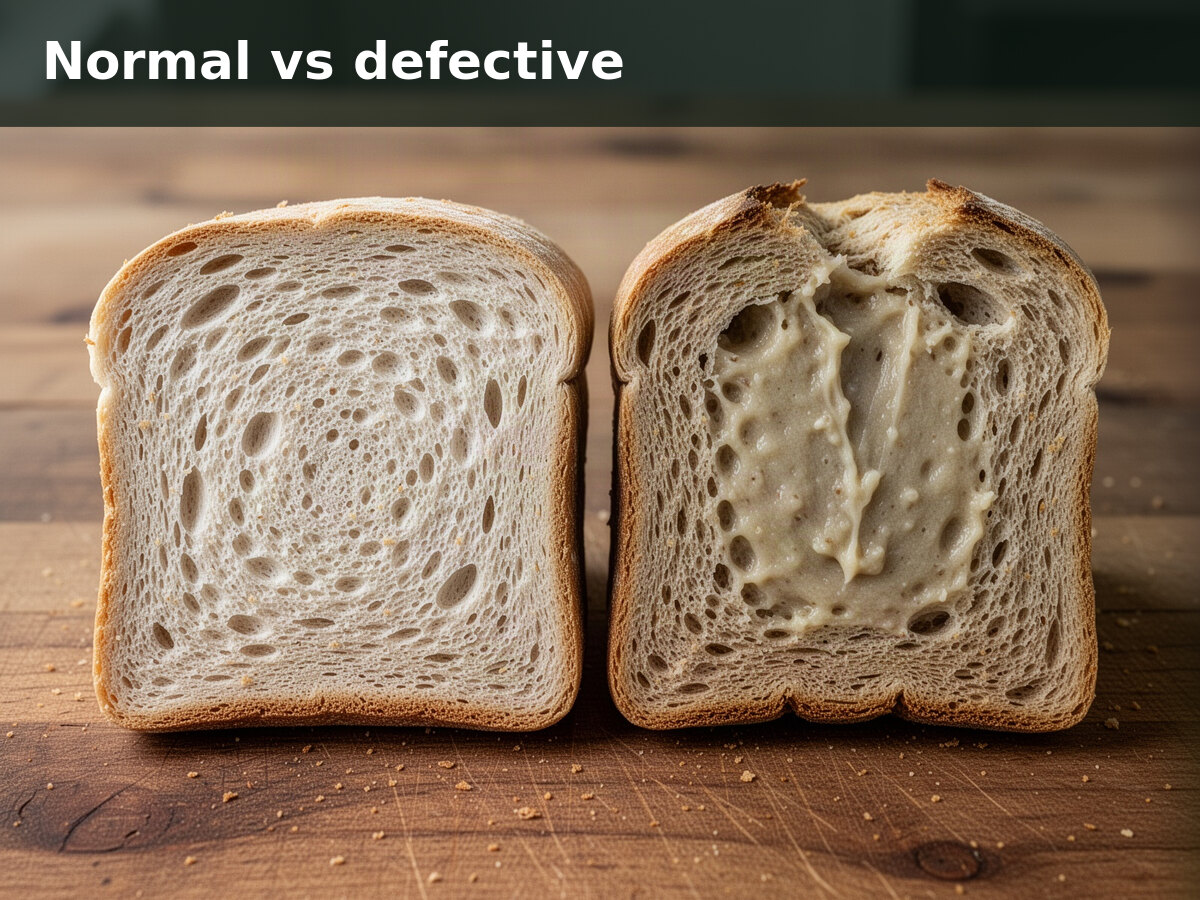
Under Table 1 the crumb must be baked through, elastic, not moist to the touch, with developed porosity and no traces of unmixed flour. The crust ranges from light yellow to dark brown, without burning. The crust must not come away from the crumb 1. Foreign inclusions, grittiness from mineral matter, and signs of disease and mould are not allowed (cl. 5.1.4) 1. A large crack, by the standard, is one running across the whole top crust and wider than 1 cm (note 1 to Table 1) 1.
What you can check at home: cut the loaf. A sticky, wet, lumpy crumb, a hollow under the crust, grit on the teeth, or a foreign smell or taste are reasons to take it back to the shop.
Weight and tolerances
Bread is made weighing 0.5 kg or more, on request from 0.3 kg, and items up to 0.3 kg are called small loaves (cl. 9.1) 1. A single unpacked item may weigh at most 3.0 % less than its set weight, and the mean of ten items at most 2.5 % less. Deviation upwards is not limited (cl. 9.2) 1. Weight is judged at the end of the maximum holding time at the bakery after leaving the oven. For packed bread the permitted shortfalls of Table 4 apply: for example, 3 % for packs over 300 up to 500 g, and 15 g for packs over 500 up to 1000 g 1.
Shelf life: 36 and 72 hours
The standard counts time from when the bread leaves the oven 1:
- at the bakery, unpacked bread may be held for no more than 10 h (wholemeal, 14 h), packed bread 20 h (cl. 10.5);
- the shelf life of unpacked bread is no more than 36 h, of packed bread no more than 72 h (cl. 10.6);
- for packed bread the producer may extend the shelf life in the approved formulation if a tasting panel and tests confirm it (cl. 10.9);
- bread is stored in dry, clean, well-ventilated rooms at +6 to +28 °C (cl. 10.7);
- frozen finished products are kept at −18 °C or below for up to 12 months (cl. 10.2–10.4).
The Ukrainian law on food information for consumers allows bakery products that are normally eaten within 24 hours of baking to go without a best-before date (art. 18, part 1, item 5) 2.
Why bread goes stale
Staling is not just drying out. The review by Gray and BeMiller concludes that it is a complex phenomenon with several mechanisms. The most plausible explanation is retrogradation of amylopectin: starch gelatinised during baking gradually recrystallises in part, builds water into those crystallites, and water shifts from gluten to starch 3. A later review confirms the central role of amylopectin retrogradation and water redistribution but stresses that proteins and non-starch polysaccharides also play a part, and that the phenomenon is still not fully explained 4.
Sourdough slows staling. Lactic acid bacteria produce organic acids, exopolysaccharides and enzymes, and the drop in pH activates the flour’s proteases and amylases; the result is a better texture and slower staling 5.
Sponge-and-dough or straight dough: what it means
The straight-dough method has one phase: the dough is mixed from all the ingredients at once. The sponge-and-dough method has two: first a sponge is made from part of the flour, water and yeast and left to ferment, then the dough is mixed with the rest. In a study of wholemeal bread with added proteins, loaves made with a sponge or with dried sourdough were softer than one-phase loaves 6. In another study of wholemeal bread, sponge dough had a stronger gluten network, and the largest specific volume and softest texture came from sourdough bread and from sponge bread with refrigerated fermentation 7. So the dough method affects the crumb and how long bread stays fresh, but the standard does not prescribe it: that is the technologist’s choice, written into the technological instruction.
A kitchen tip: stale bread is not waste. It makes croutons, rusks, breadcrumbs, bread pudding or a bake.
Gallery
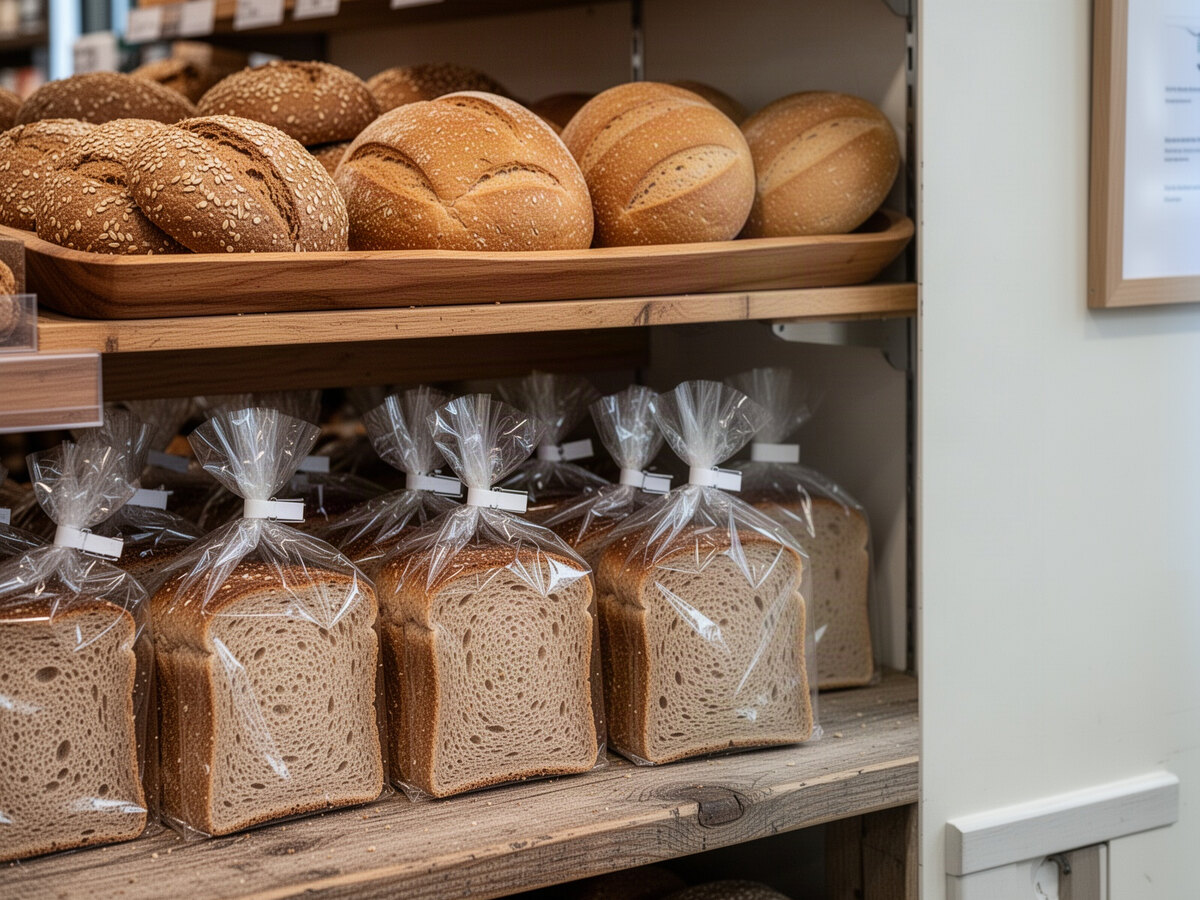
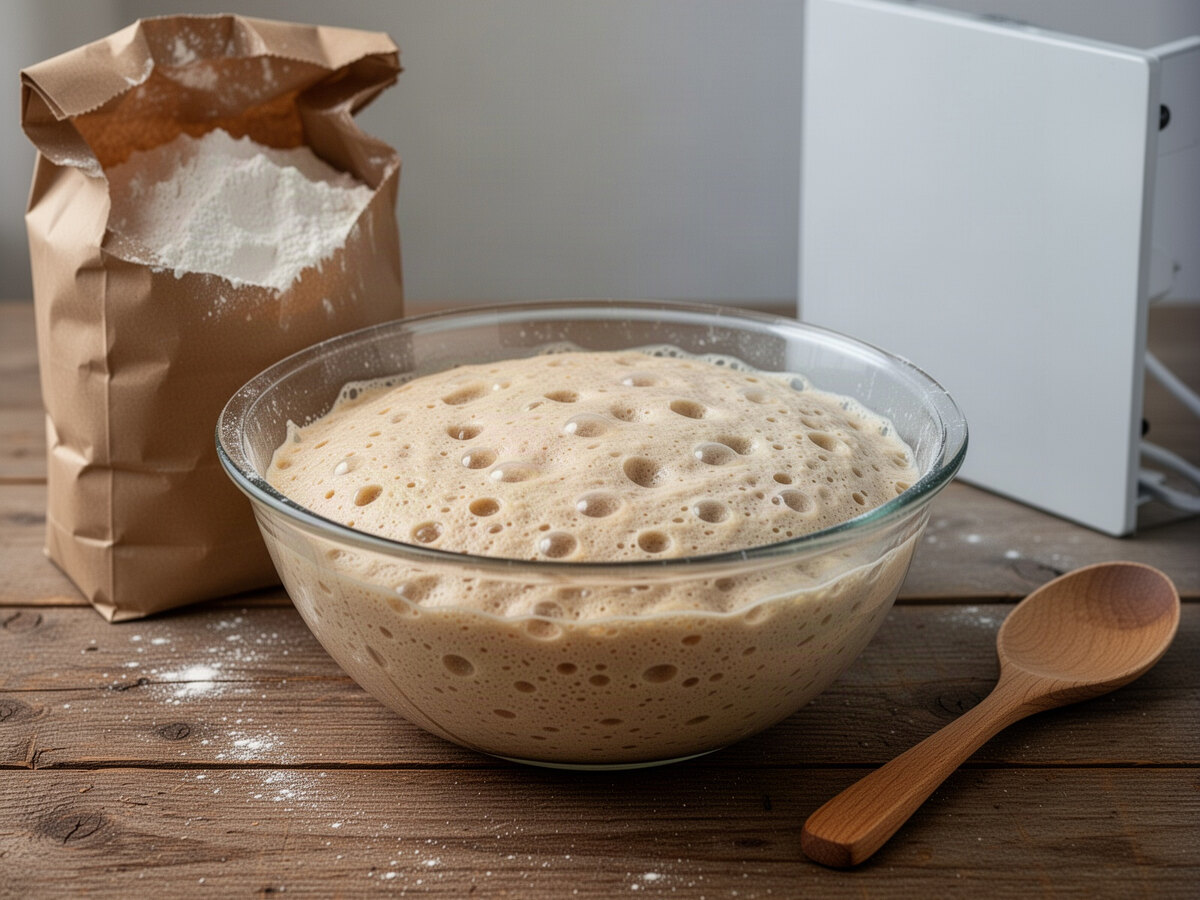
AI-generated image
In short
How long does bread keep under DSTU 7517:2024?
Unpacked bread no more than 36 h from leaving the oven, packed bread no more than 72 h, unless the producer has extended it in the approved formulation.
What crumb moisture is allowed for a loaf from highest-grade flour?
No more than 46.0 %; for tin bread the standard allows 2 % more.
Why does bread go stale even in a bag?
Mainly because starch amylopectin retrogrades and water redistributes inside the crumb, not only because it dries out.
Is sponge-and-dough bread better than straight-dough?
The standard allows both. Studies show a sponge or sourdough can give a softer crumb, but the result depends on the flour and formulation.
Sources
- ДСТУ 7517:2024 «Хліб із пшеничного борошна. Загальні технічні умови» (наказ ДП «УкрНДНЦ» № 281 від 15.11.2024, чинний з 01.05.2025, на заміну ДСТУ 7517:2014) — розд. 1, пп. 4.3, 5.1, 5.1.4, 5.1.6, табл. 1 і 3 з примітками, пп. 9.1, 9.2, табл. 4, пп. 10.2–10.7, 10.9
- Закон України «Про інформацію для споживачів щодо харчових продуктів» від 06.12.2018 № 2639-VIII — ст. 18 ч. 1 п. 5 підп. «г»
- Gray JA, BeMiller JN. Bread staling: molecular basis and control. Comprehensive Reviews in Food Science and Food Safety, 2003; 2(1): 1–21 — review
- Fadda C, Sanguinetti AM, Del Caro A, Collar C, Piga A. Bread staling: updating the view. Comprehensive Reviews in Food Science and Food Safety, 2014; 13(4): 473–492 — review
- Arendt EK, Ryan LAM, Dal Bello F. Impact of sourdough on the texture of bread. Food Microbiology, 2007; 24(2): 165–174 — review
- Stamatie GD, Susman IE, Bobea SA, Matei E, Duta DE, Israel-Roming F. The influence of the technological process on improving the acceptability of bread enriched with pea protein, hemp and sea buckthorn press cake. Foods, 2022; 11(22): 3667 — one-phase, sponge-and-dough and dried-sourdough breads compared
- Zeng F, Yang Y, Liu Q, Yang J, Jin Z, Jiao A. Effect of fermentation methods on properties of dough and whole wheat bread. Journal of the Science of Food and Agriculture, 2023; 103(10): 4876–4886 — straight, sourdough, sponge and refrigerated sponge doughs compared